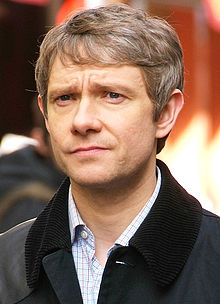
As I have thoroughly established, I am a lifelong fan of British television. I grew up watching Masterpiece Mystery with my mom and now I have developed an intense - if one sided - love affair with the Doctor from the BBC's stunning sci-fi series, Doctor Who. Through the years, I have avidly consumed British media and for the last few years, Sherlock as become one of my all time favorites.
Sherlock, written by Stephen Moffat, features the thrilling actor Benedict Cumberbatch who embodies the character of Sherlock Holmes better than any of the varied and talented actors that came before him. The writing is crisp, the dialogue pithy, and the mysteries confounding. Sadly, as with most British television, the seasons (or series as they're known across the pond) are short. In Sherlock's case, very short. The show only has three episodes per season and it's been quite a while since the cliffhanger ending of season two.
Now that I've established my personal bias, let me turn to Elementary, an American production.
During the devastatingly long interim between Sherlock seasons (and it doesn't help that Doctor Who is also on hiatus), I've been searching around for something to fill the void. Though it may seem so, I certainly do not limit myself to British television. There are several American shows that I love: The Newsroom (and the West Wing. Basically anything written by Aaron Sorkin), Game of Thrones, Smash (I love a good musical), and Grey's Anatomy (yes, I know. Keep your teasing to yourself). So I am not in any way against American programming.
I heard from several people who like Elementary and the concept of Lucy Liu as Watson was intriguing so I decided to give it a try. After seven or eight episodes (because I badly wanted to like this show), I gave up. What was wrong with it? It wasn't a bad show per se. In fact, I would consider it above average for the American crime-solving genre. But because of the timing and the connection to Sherlock Holmes lore, Elementary faces the inevitable - and inevitably detrimental - comparison with the BBC's Sherlock.
Let's start with the basics.
The Casting:
As I've said previously, I think that Benedict Cumberbatch is the greatest actor to play the Character of Sherlock Holmes ever. This obviously puts - let me look up his name - Johnny Lee Miller at a disadvantage. I think it says a lot that when you look at IMDB's Elementary page, Miller isn't even billed at the top. Which brings us to the companions. Drs John and Joan Watson. I like the risk that the American writers took casting Lucy Liu as the damaged and intensely loyal Dr. Watson. It's a great twist and I think she does a good job. I think she suffers much less by comparison with her counterpart, Martin Freeman. Once again, however, she comes to the table with a handicap because Martin Freeman, like Benedict Cumberbatch, is spot on casting and is easily the most memorable Dr. Watson of all time.
There's a reason why the fangirls are so obsessed with the Cumberbatch/Freeman pairing and it's not just their pretty eyes. They become the characters of Sherlock Holmes and John Watson so thoroughly that they cement themselves in your mental image. They are Holmes and Watson.
The Show:
Sherlock has three episodes at one and half hours a piece, which basically makes each episode a movie. Elementary, on the other hand, is limited to the approximately 45 minutes show of American prime-time. By nature of time-frame alone, Sherlock is able to delve much more deeply into each story, allowing the writer to craft an intricate and compelling mystery. Elementary, on the other hand, devolves into a typical and expected crime-solving show that happens to feature characters with the names Holmes and Watson. Oh, and Holmes is a recovering heroin-addict. Honestly that is about as much as the show has in common with the stories of Arthur Conan Doyle.
Which brings me to the main point. Casting aside - because although not nearly as good as the Cumberbatch/Freeman pairing, Miller and Liu aren't bad - the main problem with Elementary is that it's not smart. Elementary's Holmes doesn't blow me away with any cleaver deductions and the mysteries themselves are laughably predictable. The entire point of Sherlock Holmes is that he's a genius. Not only is a genius, he is THE genius. The smartest man that ever lived. A damaged yet compelling detective that solves crimes purely with the power of his amazing intellect.
There is just no comparison between the shows on an intellectual level. I STILL haven't figured how Sherlock escaped death in the last episode and I've watched it many times over. And that's the point. We need the writing to be, not only smart, but smarter than we are. We need a show that keeps us guessing. That keeps us on the edge of our seat and has enough clues and subtleties that we can watch the show over and over and still not catch everything.
This is a problem throughout American Television. The vast majority of shows lack any intellectual punch. They're dumbed down. If American television gave their writers the lee-way to write truly great shows, I have no doubt that they could do it. The problem is not that American producers aren't capable; it's that they don't give good writers the time and money needed to created a masterpiece like the BBC's Sherlock. I, for one, wish they would.
After all, smart is the new sexy.
Showing posts with label Sherlock. Show all posts
Wednesday, August 7, 2013
Elementary vs Sherlock: The Trouble with American Television
Labels:
american,
arthur conan doyle,
bbc,
Benedict Cumberbatch,
character,
Doctor Who,
dr. watson,
Elementary,
holmes,
Johnny Lee Miller,
Lucy Liu,
Martin Freeman,
masterpiece,
mystery,
Sherlock,
T.V.,
television,
TV,
writing
Wednesday, June 5, 2013
100 Writers Project: The Circle of Writing
Hey, guys! This is my entry for the 100 Writers Project. Enjoy!
A little more than a year ago, I had an idea for a book. Actually, I had an idea for a different book. One that would be expansive and intimate and breathtakingly original. Then I realized that for all my years of reading and poetry and dreaming about writing a novel... I had no idea what I was doing. So I put that book aside for a day when I had both the dream and the skill, and set about acquiring that skill. I began constructing a new story from the ground up.
World building has always been the easy part for me. My brain is in infinite supernova exploding with ideas. The hard part was focus. I narrowed the world down and worked on the characters. I gave them names and found pictures that fit them (because I'm a very visual person) and created character sketches. As for plot, I had a rough idea of the beginning and the end and I figured that the middle would sort itself out.
Now enters the essential element. At this point, my mother (also a writer) had been attending small group writing seminars by New York Times Bestselling Author, William Bernhardt. She loved them so much that she decided to sign me up for the first one. Now I've always been a type-A, teacher's pet and I thrive in a classroom environment. I expected to learn a fair-amount, but honestly, through my individual research and experience, I didn't think it would really help me much as a writer. Was I in for a shock.
The seminars last one week and at the end of that first week, I was mentally and emotional exhausted. And I learned. I learned so much about structure that my mind was spinning. I learned the importance of outlining and clear planning. I learned that I still had a lot to learn.
Since then, I've taken the next two levels of seminars and I attended the Rose State Writing Conference in Midwest City, Oklahoma that was hosted by Mr. Bernhardt and attended the lecture he gave there. After I solidified the structure it was so much easier to sit down and write because I new exactly where I was going.
The next phase in my book was NaNoWriMo. I was about 20,000 words into my manuscript when November rolled around. At first, I shied away from joining Nano, because I was under the impression that you had to do a brand new book for it. For those of you who haven't heard of NaNoWriMo, it stands for National Novel Writing Month and participants attempt to write 50,000 words in one month with the help and support of their fellow writers. Two days after Nano started, I decided, why not? I needed about 50,000 more words in my story and I wasn't going to let the fact that the story was already started stop me.
And I did it. I finished with nearly 52,000 and I'd written through the climax. I still had a scene or two to tack on at the end, but I felt pretty much finished.
Next came the editing. In this particular area, I am lucky because even though I work as a freelance editor, there was no way I could edit my own work. But there was someone who could without charging me an arm and a leg. My mother. My mother is an amazing writer and editor and only a phone call away. So the only thing I had to do was go through the manuscript line by line and clean up the flood of red ink that she'd decorated it with. That was tedious. But I made it through. I also wrote the remaining scenes and polished a few rough areas. I had a finished second draft.
I attended one last seminar by William Bernhardt that focused on perfecting the end. One more exhausting week and then about a month later, I was ready to start shopping it around.
I have yet to meet any writers that like this step. This step is about marketing and (gasp!) talking to strangers, trying to convince them to love your book as much as you do. We're writers because we like to write. If we liked selling things, we'd work in retail.
But anyway, here again, I got a leg up. At the Rose State Conference seven months earlier, I got suckered into pitching to an agent. My manuscript wasn't anywhere near finished, but one of my writing-friends said "Go on! It's good practice. So what if she's not interested? It's not even finished yet!" (you know who you are!) and I did. And it was terrifying. I wrote and memorized a solid pitch and delivered it in a satisfactory manner, even if it was a little rushed and deer-in-the-headlights-esque. And, shockingly, the agent requested the full manuscript as soon as it was done.
So now it's done. I don't know if she even remembers me, but I crafted a query letter and sent her the manuscript. Who knows how long it will take to hear back from her. But in the mean time, I'm starting again.
A new story full of breathless excitement and intense emotion. I'm back at the beginning with a blank canvas and a head full of ideas. I am writing again. And the circle starts over.
Grace Wagner
From attempting to write epic fantasy as an elementary school kid to serious drama as a teenager, she has finally finished a novel. Having grown up in a household were reading and literature were paramount, she loves any book that makes her think and she reads across all genres. She's also hopelessly addicted to British television including Doctor Who, Sherlock, and Downton Abbey. She's lucky enough to have the opportunity to be a full-time writer, spending most of her days in front of a computer screen desperately trying to write something that matters. She's kept company by the most patient of companions, her cat Matches.
For more, follow her on Twitter or Facebook. She's also on Pinterest, Google +, and Instagram. You can continue following her here, on her blog, for more on her and the 100 Writers Project. If you are interested in participating in the Project, please contact her on any of the above sites or comment below.
A little more than a year ago, I had an idea for a book. Actually, I had an idea for a different book. One that would be expansive and intimate and breathtakingly original. Then I realized that for all my years of reading and poetry and dreaming about writing a novel... I had no idea what I was doing. So I put that book aside for a day when I had both the dream and the skill, and set about acquiring that skill. I began constructing a new story from the ground up.
World building has always been the easy part for me. My brain is in infinite supernova exploding with ideas. The hard part was focus. I narrowed the world down and worked on the characters. I gave them names and found pictures that fit them (because I'm a very visual person) and created character sketches. As for plot, I had a rough idea of the beginning and the end and I figured that the middle would sort itself out.
Now enters the essential element. At this point, my mother (also a writer) had been attending small group writing seminars by New York Times Bestselling Author, William Bernhardt. She loved them so much that she decided to sign me up for the first one. Now I've always been a type-A, teacher's pet and I thrive in a classroom environment. I expected to learn a fair-amount, but honestly, through my individual research and experience, I didn't think it would really help me much as a writer. Was I in for a shock.
The seminars last one week and at the end of that first week, I was mentally and emotional exhausted. And I learned. I learned so much about structure that my mind was spinning. I learned the importance of outlining and clear planning. I learned that I still had a lot to learn.
Since then, I've taken the next two levels of seminars and I attended the Rose State Writing Conference in Midwest City, Oklahoma that was hosted by Mr. Bernhardt and attended the lecture he gave there. After I solidified the structure it was so much easier to sit down and write because I new exactly where I was going.
The next phase in my book was NaNoWriMo. I was about 20,000 words into my manuscript when November rolled around. At first, I shied away from joining Nano, because I was under the impression that you had to do a brand new book for it. For those of you who haven't heard of NaNoWriMo, it stands for National Novel Writing Month and participants attempt to write 50,000 words in one month with the help and support of their fellow writers. Two days after Nano started, I decided, why not? I needed about 50,000 more words in my story and I wasn't going to let the fact that the story was already started stop me.
And I did it. I finished with nearly 52,000 and I'd written through the climax. I still had a scene or two to tack on at the end, but I felt pretty much finished.
Next came the editing. In this particular area, I am lucky because even though I work as a freelance editor, there was no way I could edit my own work. But there was someone who could without charging me an arm and a leg. My mother. My mother is an amazing writer and editor and only a phone call away. So the only thing I had to do was go through the manuscript line by line and clean up the flood of red ink that she'd decorated it with. That was tedious. But I made it through. I also wrote the remaining scenes and polished a few rough areas. I had a finished second draft.
I attended one last seminar by William Bernhardt that focused on perfecting the end. One more exhausting week and then about a month later, I was ready to start shopping it around.
I have yet to meet any writers that like this step. This step is about marketing and (gasp!) talking to strangers, trying to convince them to love your book as much as you do. We're writers because we like to write. If we liked selling things, we'd work in retail.
But anyway, here again, I got a leg up. At the Rose State Conference seven months earlier, I got suckered into pitching to an agent. My manuscript wasn't anywhere near finished, but one of my writing-friends said "Go on! It's good practice. So what if she's not interested? It's not even finished yet!" (you know who you are!) and I did. And it was terrifying. I wrote and memorized a solid pitch and delivered it in a satisfactory manner, even if it was a little rushed and deer-in-the-headlights-esque. And, shockingly, the agent requested the full manuscript as soon as it was done.
So now it's done. I don't know if she even remembers me, but I crafted a query letter and sent her the manuscript. Who knows how long it will take to hear back from her. But in the mean time, I'm starting again.
A new story full of breathless excitement and intense emotion. I'm back at the beginning with a blank canvas and a head full of ideas. I am writing again. And the circle starts over.
Grace Wagner
From attempting to write epic fantasy as an elementary school kid to serious drama as a teenager, she has finally finished a novel. Having grown up in a household were reading and literature were paramount, she loves any book that makes her think and she reads across all genres. She's also hopelessly addicted to British television including Doctor Who, Sherlock, and Downton Abbey. She's lucky enough to have the opportunity to be a full-time writer, spending most of her days in front of a computer screen desperately trying to write something that matters. She's kept company by the most patient of companions, her cat Matches.
For more, follow her on Twitter or Facebook. She's also on Pinterest, Google +, and Instagram. You can continue following her here, on her blog, for more on her and the 100 Writers Project. If you are interested in participating in the Project, please contact her on any of the above sites or comment below.
Labels:
100 writers,
100 writers project,
author,
bestselling,
Doctor Who,
Downton Abbey,
emotion,
experiences,
Grace Wagner,
Nanowrimo,
new project,
New York Times,
novel,
Sherlock,
william bernhardt,
write,
writers,
writing
Wednesday, January 16, 2013
5 TV Shows for Writers to Watch
I watch a lot of T.V. and in many ways I prefer television shows to movies. You get to know the characters better and, ultimately, you get to see them more. Especially if it's a popular show with many seasons. Recently, I've been watching these shows not as a passive observer, but as a writer. I take note of the conflict, dialogue, and pacing that the writers of these shows use to tell their story, because writing a novel is basically the same thing. Same idea, different medium.
So here's a list of five shows that exhibit excellent writing and are worth watching both for entertainment and as a writer.
1. Sherlock
5. Downton Abbey
Downton Abbey is the runaway hit that follows the inhabitants of its namesake through the sinking of the Titanic, World War I, and beyond. Placed against the beautiful back drop of an Edwardian era manor house, an ensemble cast of characters ranges from the lowliest kitchen maid to the Earl of Downton himself. Each character is amazingly well-cast with individual and vibrant personalities. The interpersonal conflict is what drives the story forward without the need for contrived melodrama or explosions. Reaching beyond its genre's usual audience of Jane Austen lovers (count me as one of those), Downton Abbey has managed to hook all kinds of watchers. As a writer, it is very much worth watching for the snappy dialogue, what is said, as well as the underlying tensions, what is not said. This series excels at touching overarching themes through the characters lives and subtle pacing that draws the watcher along until they are completely addicted.
These are five of my favorite T.V. shows and the ones that I think would benefit any writer to watch.
What are some of yours?
So here's a list of five shows that exhibit excellent writing and are worth watching both for entertainment and as a writer.
1. Sherlock
Sherlock is the modern re-imagining of Sir Arthur Conan Doyle's timeless mystery series following the antics of genius detective, Sherlock Holmes. The T.V. series takes place in modern day London, placing the characters firmly in the real world yet still managing to stay true to the original plots. Aside from the stunning acting done by Benedict Cumberbatch (Sherlock) and Martin Freeman (Dr. Watson), this show is exceedingly well written. The sharp and intelligent dialogue between the two lead characters is engaging and addictive, while the lead characters themselves are immediately relatable and interesting. The show's constant flow of wit and excitement keeps the pace up through the hour and half long episodes placing the watch firmly in it's thrall. Sadly, there are only three episodes per season.
2. Homeland
Homeland is the best psychological thriller on T.V. It brings what is a very popular genre in books to the world of television. Following the paths of C.I.A. counter-terrorist agent Carrie and alleged captive-turned-terrorist Lt. Brodie, Homeland has swept a nation already hooked on thrillers in book-form. Not only is this show exciting because of its basic premise, but the writers do an excellent job of gradually reveling information. They don't present everything you need to know right away, instead drawing both past and present events out through the eyes of the characters. Trusting your audience to figure somethings out for themselves and only giving just enough hints to keep them going is essential to any "thriller" story, but even in other genres adding a layer of hidden depth with make any story better.
3. Doctor Who
Doctor Who has been a staple in the Sci Fi genre for decades, but the most recent reboot (starting in 2005 with Christopher Eccleston) has gone further than the original. While the initial seasons still have genre-specific themes and questionable graphics, Doctor Who really shows itself to be deeper than many outsiders can understand. The most recent seasons are especially well done crossing all genres including Science Fiction, Mystery/Thriller, Drama - even tossing in a bit of romance for good measure. But what the writers do best in this series is the characters. The characters are vibrant, original, and very much their own. Dialogue, clothing, and idiosyncrasies are expertly woven together to give life to these characters who are at their worst, human, and at their best, still very much human.
4. The Newsroom
From the creator of the West Wing, the Newsroom is a sharp, intelligent exploration of the characters involved in the media today. It follows idealistic news anchor William MacAvoy and an ensemble cast of a fictional cable news channel dealing with and presenting actual news. The writers do an excellent job of weaving fictional characters around fact-based events, while at the same time using their story to present the watcher with harsh truths about today's world. A constant stream of witty dialogue, actual catastrophes, and almost slap-stick personal problems creates a story-world that is exciting, scary, hilarious, heart-wrenching, and deeply relevant to its audience.
5. Downton Abbey
Downton Abbey is the runaway hit that follows the inhabitants of its namesake through the sinking of the Titanic, World War I, and beyond. Placed against the beautiful back drop of an Edwardian era manor house, an ensemble cast of characters ranges from the lowliest kitchen maid to the Earl of Downton himself. Each character is amazingly well-cast with individual and vibrant personalities. The interpersonal conflict is what drives the story forward without the need for contrived melodrama or explosions. Reaching beyond its genre's usual audience of Jane Austen lovers (count me as one of those), Downton Abbey has managed to hook all kinds of watchers. As a writer, it is very much worth watching for the snappy dialogue, what is said, as well as the underlying tensions, what is not said. This series excels at touching overarching themes through the characters lives and subtle pacing that draws the watcher along until they are completely addicted.
These are five of my favorite T.V. shows and the ones that I think would benefit any writer to watch.
What are some of yours?
Labels:
Benedict Cumberbatch,
character,
David Tennant,
dialogue,
Doctor Who,
Downton Abbey,
drama,
fiction,
Homeland,
Jane Austen,
Matt Smith,
mystery,
Newsroom,
plot,
sci fi,
Sherlock,
T.V.,
TV,
writers,
writing
Subscribe to:
Posts (Atom)